





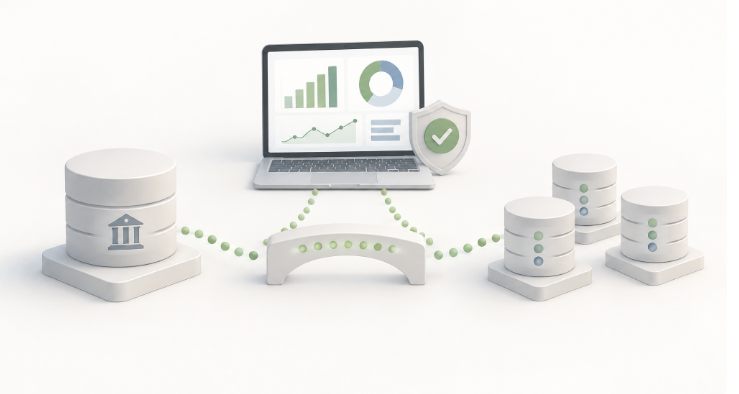
The FLAIR to PALM migration will change more than Florida’s accounting system. It will also affect the data that agencies use for reports, dashboards, and daily work. If your reports rely on FLAIR data, they may need changes before they can work with Florida PALM. Planning ahead can help your team find those reports and decide what to do next.
This post walks through what changes when the data foundation moves, why the reports that depend on it are at risk, and a practical way to approach the transition. It is written for the people who own financial reporting in a state agency and need to know what to protect first.
If you are working through this in your own environment, you can reach out to us at Arc Qlik Consulting Services. We can help you see what your reports depend on and plan the work ahead.
Why a FLAIR to PALM migration reaches beyond the accounting system
FLAIR is the State of Florida’s accounting system. It has served state agencies for decades and records the financial activity that programs, bureaus, and offices rely on to report. Florida PALM is the new system that replaces it, and the transition goes live on January 12, 2027. The State’s move from FLAIR to Florida PALM is a major, multi-year effort to modernize the State’s financial systems.
The conversion itself moves opening balances and active records from FLAIR into Florida PALM, and a new data warehouse holds both the new data and historical FLAIR information. That part is the project. For a finance team, the harder question is what happens to the reports and workflows that read from that data.
Why your reports and workflows are at risk
Florida PALM does not organize data the same way FLAIR does. FLAIR uses a large fact table and reference tables. Florida PALM uses separate modules, like an enterprise resource planning system. As a result, data may be stored and organized differently after the move.
Reports built for FLAIR may not work as expected with Florida PALM. They could stop working or return incorrect numbers. Even if a report answers the same question, your team may need to adjust or rebuild it to work with the new data layout.
| Aspect | FLAIR today | Florida PALM |
|---|---|---|
| Structure | Large fact table and reference tables | Module-based, ERP-style structure |
| Historical data | Full transaction history | Opening balances; history kept in the data warehouse |
| Existing reports | Built to read FLAIR’s layout | Must be reviewed and rebuilt |
How to Prepare Reports for the FLAIR to PALM Migration
The teams that manage this well start before go-live, not after. Additionally, the work breaks into a few clear steps. Because the new structure changes how the data is laid out, the work is also a data integration problem, connecting reports to data that no longer has the same layout.
- Find what relies on FLAIR data. Make a list of reports, applications, and workflows that use data affected by the transition. This is the step most teams skip, and the one that causes the most trouble later.
- Triage what you find. Not every report carries the same weight. Sort the list by how much the work depends on it, how often it runs, and what it is used for, so the team can focus on what matters most.
- Plan recovery or remediation. For the reports that will break, decide what happens next: rebuild them, adjust them, or replace them. This is where the real work lives. For agencies that need to move data and build governed pipelines, our Qlik Talend Cloud Consulting team handles migration from legacy tools with a focus on continuity and risk reduction.
- Look ahead to new reports. Florida PALM opens new ways to report. The transition is a chance to build the reports the team will want after go-live, not just carry the old ones across.
Why teams that already know FLAIR have an edge
There is a real advantage in working with a team that has spent time in FLAIR. Records in FLAIR are categorized, coded, and treated in specific ways, and that knowledge does not transfer on its own to a new system. A team that has already worked with FLAIR data in financial reporting can read the old structure and understand what each number meant, which makes the audit and triage faster and more accurate.
Arc Analytics has supported financial reporting for a Florida state department through the earlier stages of this transition. That work included working with FLAIR data, auditing the applications that rely on it, triaging which reporting needs attention, and planning how to recover or remediate affected reports. The goal is to move from the reports that depend on FLAIR to the reports the department will need on Florida PALM. That effort builds on related FLAIR reporting work across different parts of the department. For example, county accounting structures, grant cycles, and program-specific needs all shape how financial information is presented.
For public sector teams, that is why data solutions for state and local government start with understanding what your data means before you move it.
Looking ahead
The transition to Florida PALM is not something a reporting team can wait on. The reports and workflows that depend on FLAIR need attention before go-live, and the work to rebuild them for the new system is best done while the team still has time and access to the old data. As a result, the earlier a team starts, the less trouble the cutover causes.
If you are a finance or IT leader at a Florida agency and are not sure what your reports depend on, you can reach out to us at Arc Qlik Consulting Services. We can help you audit what relies on FLAIR, plan what to rebuild, and get ready for Florida PALM.